

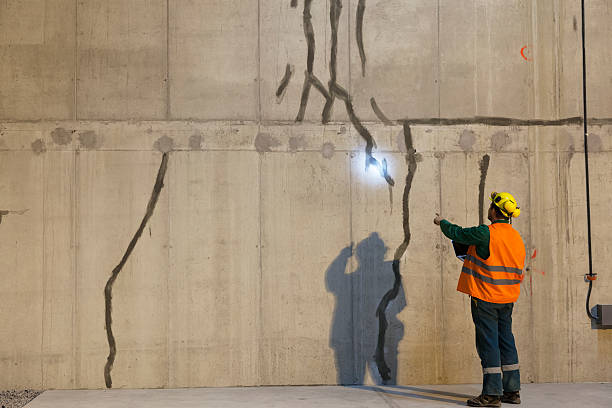
Every concrete foundation cracks. Concrete shrinks as it cures, expands and contracts with temperature, and reacts to soil movement below. The question is never whether there is a crack, but whether this crack is normal.
Three forces cause the cracks you see:
Curing shrinkage: Concrete loses water as it hardens. The volume reduces. Internal stress creates microscopic to small cracks. Most happen within the first year of construction and stop growing.
Thermal cycling: Concrete expands in heat and contracts in cold. Repeated cycles open and close micro-cracks at expansion joints and edges.
Soil movement: Below-grade soil moves as the moisture content changes. In Texas, clay soils swell when wet and shrink when dry. The slab moves with the soil. Differential movement (one part moves more than another) causes the cracks that matter.
A 30-year-old slab with a network of fine cracks is normal. A 5-year-old slab with a 1/4-inch crack that has grown over the last year is not.
Hairline cracks: shrinkage vs structural
Hairline cracks are less than the width of a credit card edge (about 1/16 inch). They appear in patterns that tell you the cause.
Random branching cracks across a slab surface: Curing shrinkage. Almost universal in slab-on-grade homes. Not structural.
Cracks at the corners of expansion joints: Stress concentration. Normal.
Cracks running parallel to the long edge of a garage slab: Often, shrinkage in oversized pours that lack proper joint spacing. Not structural.
Hairline cracks at the corners of doorways or windows in a basement wall: Settlement at corners. Monitor, but usually not urgent.
Hairline horizontal crack mid-wall in a basement or stem wall: Different category. See the horizontal cracks section below.
For hairline cracks that are random or shrinkage-pattern, mark the date and crack ends with a pencil and check in 6 months. If they have not grown, you can stop worrying.
Vertical cracks: usually okay
Vertical cracks run up and down along the height of a wall or across the width of a slab. They typically result from:
- Settlement (one side of the foundation has dropped slightly more than the other)
- Concrete shrinkage (in walls, vertical cracks are common at form ties)
- Thermal expansion and contraction over the years
Width matters more than presence.
- Less than 1/16 inch: monitor. Almost always cosmetic.
- 1/16 to 1/8 inch: monitor closely. Mark and re-measure quarterly. Often stable.
- 1/8 to 1/4 inch: Schedule a foundation contractor evaluation. May be active.
- 1/4 inch or wider: structural engineer review. Significant settlement.
Active cracks are growing or showing fresh edges (sharp, light gray). Inactive cracks are dirty, weathered, and stable. Active cracks need attention regardless of width.
Where the crack is matters. A vertical crack mid-wall in a basement is more concerning than the same crack at a corner. Mid-wall cracks bisect the wall’s structural section. Corner cracks indicate localized settlement that often stabilizes.
Horizontal cracks: red flag
Horizontal cracks running along a basement or retaining wall are the most serious type. They indicate the wall is failing under lateral pressure from the soil outside.
Causes:
- Hydrostatic pressure (water-saturated soil pushing on the wall)
- Frost heave (in colder climates)
- Soil expansion (clay soil swelling against the wall)
- Construction defect (under-reinforced wall)
Signs that confirm a serious problem:
- Bulging of the wall toward the interior
- Step in the crack (one side has moved relative to the other)
- Water seepage through the crack
- Crack pattern crosses the wall horizontally for more than 4 to 6 feet
- A new crack is appearing on a previously sound wall
A horizontal crack with bulging is a structural emergency. The wall is at risk of failure. Avoid putting weight against the inside of the wall, do not store anything heavy on the outside (including landscape stone, planters, vehicles), and call a structural engineer.
Repairs for horizontal cracks typically involve:
- Soil pressure relief (drainage, exterior excavation)
- Wall reinforcement (carbon fiber straps, steel I-beams, helical tiebacks)
- In severe cases, wall reconstruction
Costs range from $4,000 to $25,000+, depending on severity and method.
In Texas slab-on-grade homes, horizontal cracks are uncommon because there are no basement walls to push against. The Texas equivalent is heaving slab edges, addressed differently.
Diagonal cracks: depends on location
Diagonal cracks (cracks running at an angle) usually start from a stress concentration point.
Most common locations:
- Corners of doors and windows in a slab home (drywall cracks at corners trace foundation movement below)
- Corners of basement window wells
- Edges of the slab where it meets the foundation wall
- Corners of garage door openings
What they mean:
A diagonal crack from a corner indicates differential settlement, where one side of an opening has moved more than the other. This is the visible result of the slab below moving unevenly.
Severity by width:
- Hairline at the corner: very common, watch
- 1/8 inch widening from the corner: likely active, evaluate
- 1/4 inch+ stair-stepping into the wall: significant movement, engineer review
In Texas, diagonal cracks in drywall at door corners are extremely common because of clay soil movement. Most homes have one or two. Multiple diagonal cracks growing over time indicate ongoing foundation movement that should be evaluated.
Stair-step cracks in brick or block
Stair-step cracks follow the mortar joints in brick or concrete block, creating a zigzag pattern that goes up and over (or down and over) like stair steps.
What they indicate:
The wall is shifting. The mortar joints are the weakest points, and the crack follows them. A stair-step pattern is almost always a sign of foundation movement, not just cosmetic.
Causes:
- Foundation settlement on one side of the building
- Soil expansion under one corner
- Moisture damage to the brick veneer
- Inadequate footing depth at the affected location
Severity:
- Hairline stair-step: monitor, common in older brick veneer
- 1/8 to 1/4 inch wide stair-step: foundation contractor evaluation
- Larger or growing stair-step: structural engineer
Brick stair-step in slab-on-grade homes: very common in DFW. Most are caused by clay soil movement under the foundation edge. Repair often involves underpinning or pier installation along the affected wall.
Slab cracks visible from inside the home
Slab cracks usually hide under the flooring. You see them when:
- Floor coverings are removed
- Tile or stone flooring cracks along the path of the slab crack
- Carpet wrinkles or wears in a line
Common patterns:
Single straight crack across the slab: Often shrinkage from the original pour. Rarely structural.
Wavy or branching crack: Could be settlement-related. Width matters.
Crack with one side raised relative to the other: Vertical displacement indicates differential settlement. Always evaluate.
Crack along an interior load-bearing wall line: Can be settlement under that wall. Evaluate.
If you see crack patterns appearing in tile flooring or trim, look for the underlying slab pattern. Mapping the cracks helps the engineer understand the movement.
How to measure and monitor cracks
DIY crack monitoring saves money and gives the engineer real data.
Equipment:
- Crack monitor card (free from foundation contractors or $5 online)
- Or, a ruler with tenths-of-an-inch markings
- Pencil and dated notes
- Phone camera for time-stamped photos
Process:
- Mark the ends of the crack with a pencil and the date
- Mark the widest point with a tick
- Photograph with date stamp
- Measure width at the widest point
- Repeat every 30 to 90 days
Crack monitor cards are clear plastic with grid lines. Tape one across the crack and read the position over time. They make small movements obvious.
What you are looking for:
- Lengthening (the pencil ends from earlier are no longer at the crack’s end)
- Widening (the gap is growing)
- Vertical displacement (one side is rising or falling relative to the other)
- New crack growth radiating from the original
A crack that is stable for 12+ months is rarely a structural concern. Active cracks need professional evaluation.
When to call an engineer vs a foundation contractor
These are different services.
Structural engineer:
- Independent professional, no incentive to sell repairs
- Charges $400 to $800 for a residential foundation evaluation
- Provides a written report with findings and recommended actions
- Best when you need an objective assessment for a real estate transaction or insurance claim
Foundation contractor:
- Sells and performs repairs
- Often offers free evaluation, but with a bias toward selling work
- Useful for getting repair quotes after an engineer has identified the problem
- Some are honest, some upsell aggressively
Best practice:
- 1An engineer evaluates first if you suspect a real problem
- Get the engineer’s recommended scope in writing
- Get 2 to 3 contractor quotes for the engineer-recommended scope
- Some are honest, some upsell aggressively
This sequence protects you from contractors selling unnecessary work and from cheap contractors performing inadequate work.
Final Thought
Foundation cracks can look alarming at first glance, but they’re often part of how a home naturally responds to time, weather, and soil movement. The real skill isn’t spotting a crack—it’s interpreting what it’s trying to tell you. Some lines are simply the footprint of concrete drying and settling, while others reflect deeper shifts happening beneath the structure.
What matters most is not reacting instantly to every visible split, but paying attention to patterns: whether the crack is growing, changing direction, or showing signs of displacement. A stable crack that hasn’t changed in months is usually just part of the home’s history, while an active one is a signal worth investigating further with a trained eye.When uncertainty creeps in, having a professional set of eyes on the situation can turn guesswork into clarity. That’s where experience-driven evaluations from Futuristic Inspections help homeowners move from concern to confidence, with clear answers instead of assumptions.
Frequently Asked Questions
Are foundation cracks covered by homeowners’ insurance?
Usually not. Standard policies exclude foundation movement, settlement, and earth movement. Some policies cover sudden damage from pipe leaks under the slab. Read your policy carefully.
How much does foundation repair cost?
$2,000 to $4,000 for a few piers under a corner. $7,000 to $15,000 for a typical Texas slab repair with multiple piers. $25,000+ for major movement requiring extensive piering or slab work.
Will foundation cracks lower my home’s value?
Hairline shrinkage cracks: minimal effect. Active structural cracks or evidence of past major repair: 3 to 10% reduction unless documented and warranted.
Can I fill a foundation crack with caulk?
Cosmetically, yes; structurally, no. Caulk does not stop movement. Filling a crack hides the indicator, not the problem. Use crack monitors instead.
Why do new homes get foundation cracks?
Curing shrinkage in the first year is universal. Settlement of the soil under the home for the first 2 to 3 years is also common. Most “new home cracks” are not concerning if they stabilize.