

Yes, most North Texas buyers should add a sewer camera check, especially on any home built before the mid-1990s. A standard home inspection stops at the fixtures. It does not send a camera into the buried main line, which is exactly where the expensive problems hide in Dallas and old Plano. For a fee in the low hundreds, we run a camera the full length of the main and show you cracked cast iron, root-filled clay joints, or a sagging “belly” before you close. A missed line defect can run four to five figures to fix. The camera fee is a rounding error against that number.
What You’ll Walk Away Knowing
Buying in Frisco, Plano, McKinney, Prosper, Dallas, or Little Elm means buying whatever pipe is buried under the slab, and no two eras of homes carry the same risk. Below, we walk through what the camera actually sees inside older cast iron and clay lines, why the Blackland Prairie clay under your feet is the reason so many of these lines fail, the honest math on a missed defect versus the scope fee, and when it is worth adding on a resale versus a brand new build. By the end, you will know whether to spend the extra hundred-something dollars on your specific address or skip it with clear eyes.
What a Sewer Scope Inspection Actually Sees
A sewer scope inspection sends a small waterproof camera on a flexible cable down the main sewer line, from a cleanout or an accessible drain all the way to where it ties into the city main or the septic system. We watch the video live and record it, so you see the inside of the pipe the same moment we do. A standard home inspection cannot do this. Your inspector checks that drains run and toilets flush, but the buried line between the house and the street is invisible from the fixtures. That gap is the whole point of the add-on. The line can drain fine on inspection day and still be one root ball or one soil shift away from a backup into the house.
Here is what the camera catches in North Texas homes specifically:
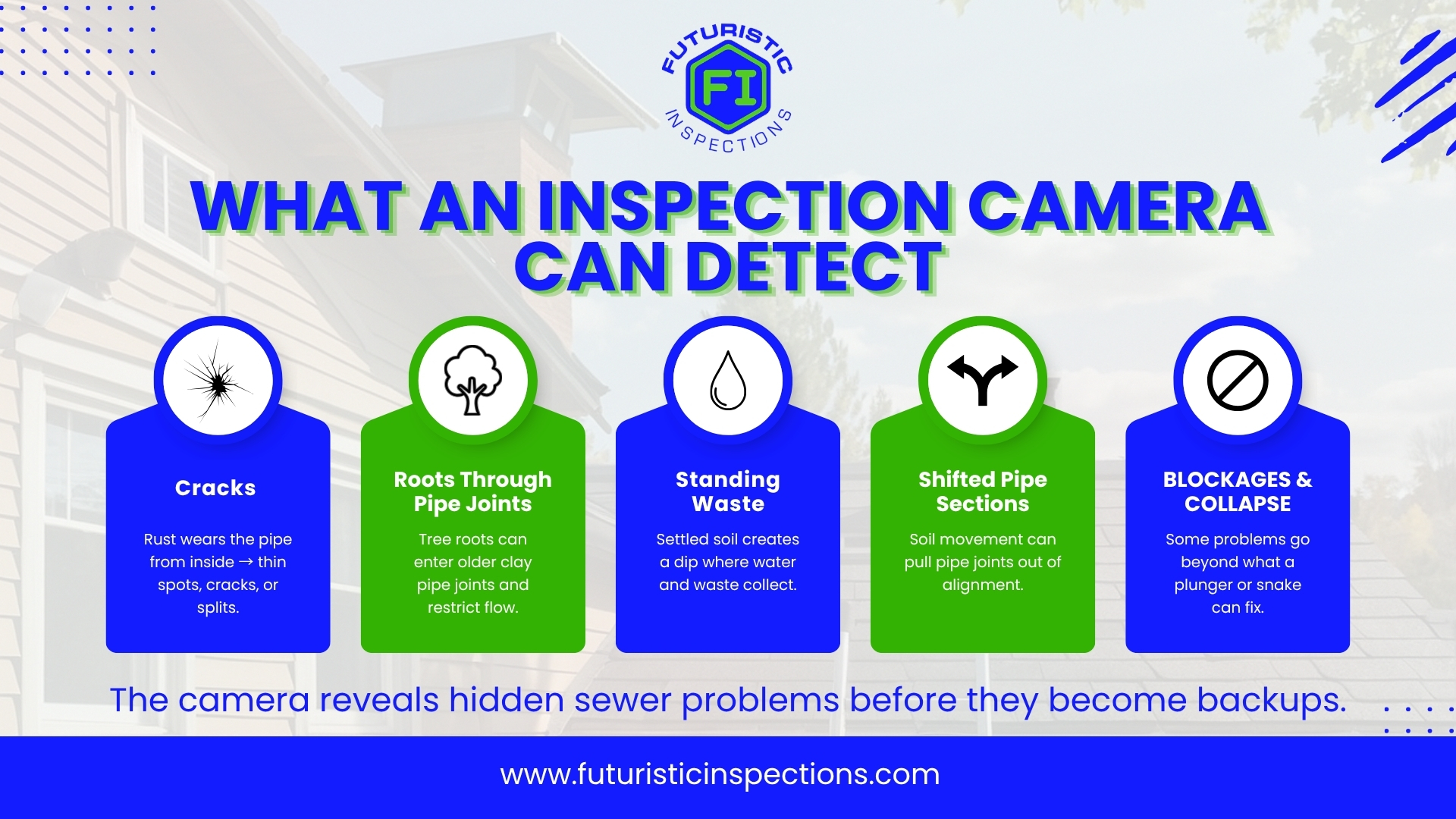
- Cracks and channeling in cast iron, where the pipe has rusted from the inside out, and the bottom has worn thin or split open.
- Root intrusion at clay pipe joints, common in older Plano and East Dallas neighborhoods where mature trees sit near the line.
- Bellies, a low sag in the line where the ground settled, and waste now pools instead of draining by gravity.
- Offsets and separations, where two sections of pipe have shifted apart because the soil moved under them.
- Blockages, grease, and collapsed sections that a plunger and a snake will never fix.
Why the pipe material tells you most of the story
The single biggest predictor of what we find is when the house was built, because that decides what the line is made of. In the DFW area, homes built roughly from 1950 into the mid-1980s were plumbed with cast iron, and the oldest ones in Plano and Dallas often still have clay tile laterals from the 1950s and 1960s. Cast iron has a working life of around 40 to 60 years, so a 1970s Dallas home is sitting right at or past the end of that window. Clay is even more fragile at the joints, where roots find their way in.
Around the mid-1980s, DFW builders switched to PVC for underslab sewer lines, and PVC is what runs under nearly every newer home in Frisco, Prosper, McKinney, and the Little Elm developments. PVC does not rust and does not rot, which is why the scope conversation is different for a 2015 build than for a 1972 build. Not zero, but different, and we get to that below.
The Blackland Prairie: Why North Texas Lines Fail More
This is the local piece most out-of-state guides miss, and it is the reason a sewer scope inspection earns its keep here more than in a lot of the country.
North Texas sits on the Blackland Prairie, a band of highly reactive clay soil. This clay swells when it gets wet and shrinks hard when it dries out, and it does this every year with our wet springs and brutal drought summers. The ground under your slab is quite literally moving up and down through the seasons.
Rigid pipe does not like that. Cast iron and clay lines are brittle, so instead of flexing with the soil they crack, shear at the joints, or settle into a belly. That is why we pull so many bad-line videos out of homes that “never had a plumbing problem.” The house drained fine right up until the clay pulled a joint apart.
From what we see on jobs across Collin and Denton counties, two homes built the same year on the same street can scope completely differently depending on how the lot drains and how close the big trees sit. Soil movement is not uniform even within one neighborhood. That is why we scope the actual line rather than guessing from the build year alone. The year tells you the material and the odds. The camera tells you the truth about that specific address.
The Real Math: A Missed Defect vs. the Scope Fee
The whole case for a sewer scope comes down to one lopsided comparison. Here is the honest version, with numbers labeled as ranges, not guarantees.
| What you are looking at | Typical DFW range | Notes |
| Sewer scope inspection add-on | about $125 to $300 | Less when bundled with the full home inspection |
| Spot repair (one bad section, dig access) | about $1,500 to $5,000 | Depends on depth and whether it is under the slab |
| Full main line replacement, cast iron to PVC | roughly $8,000 to $25,000+ | Under-slab and long runs sit at the top of the range |
| Trenchless pipe lining or bursting | mid four figures to low five figures | Avoids some slab demolition, priced per project |
Treat these as ballpark ranges for the DFW market, not quotes. The point is the gap. A scope in the low hundreds is protecting you against a repair that routinely runs many thousands, and in the worst cases, a full under-slab replacement in an older Dallas home, lands in five figures.
There is a second payoff that does not show up in a repair invoice: negotiating power. If the camera finds a real defect while you are still under your option period, that video is a bargaining chip. Buyers use scope findings to get a seller credit or have the repair handled before closing. Without the video, you inherit the problem and pay for it yourself in year two.
When to Add a Sewer Scope on a Resale
On a resale, our default answer is yes, and it gets closer to a flat yes the older the home is. A few honest tiers:
- Built before 1985, cast iron or clay era: add it, no hesitation. This is the highest-value scope we do.
- Built 1985 to late 1990s, likely early PVC but worth confirming: add it, especially if there are large trees, past foundation work, or any drain that runs slow.
- Newer resale with PVC and no red flags: lower odds of a problem, but the fee is small enough that most buyers still add it for peace of mind.
Whichever tier your home falls into, we can bundle the sewer scope inspection with your main inspection so it all lands on one report and one timeline. Watch for the tells that push a scope from optional to necessary: mature trees within about ten feet of the line, a slab that has had foundation repair (that work can stress the pipe), slow or gurgling drains, or a suspiciously green patch of lawn over the line. Any of those, and we would scope it regardless of build year.
Do New Builds in Frisco and Prosper Need One Too?
This is where we push back on the common advice that new construction is automatically safe. It usually is fine. But “usually” is not “always,” and a new build is not a free pass.
Two things go wrong on new lines. First, construction damage: heavy equipment, backfill, and other trades working over an open trench can crack or crush a section before the slab is even poured, and nobody sees it because it is buried. Second, debris left in the line, chunks of concrete, mud, or dropped tools, which show up as partial blockages on the very first scope.
There is also a North Texas wrinkle. The post-tension slabs standard in newer Frisco, McKinney, and Prosper homes are engineered to resist our clay movement, which is good. But when a new home does settle in its first year or two, a fresh PVC joint can still pull, or a belly can still form in poorly compacted backfill. A scope on a new build, ideally at your final walkthrough or during a builder warranty inspection, catches these while the builder still owns the fix.
So the honest answer for a new build: the odds are lower than on a 1970s home, but a first scope is cheap insurance and the best time to use your builder warranty. We would rather you know now than turn up a construction defect after the warranty lapses.
How the Scope Fits Into Your Inspection Timeline
Timing matters because your negotiating power lives inside the option period. In a typical DFW transaction, you have a short window after going under contract to inspect and negotiate. The sewer camera inspection should ride along with your main home inspection, not be scheduled as an afterthought two days before the deadline.
Practical order of operations:
- Go under contract, start your option period.
- Book the full home inspection and add the sewer scope to the same visit.
- Review the recorded video and the report together.
- If there is a defect, use the footage to negotiate a credit or a repair before the option period closes.
Bundling the scope with the main inspection is also usually cheaper than calling a separate company out, and it keeps everything on one report and one timeline. When you are ready, you can schedule your inspection and add the sewer camera run in the same booking.
What Happens After the Camera Finds a Problem
Finding a defect is not the end of the deal. In our experience, it is usually the start of a better one for the buyer, because now you are negotiating with facts instead of a vague worry.
The report and the recorded video give you three practical paths. You can ask the seller to repair the line before closing, which is common when the fix is a defined spot repair. You can ask for a credit at closing and handle the work yourself with a plumber you trust, which many buyers prefer because they control the quality of the repair. Or you can ask for a price reduction that reflects the cost of the future work. Which route makes sense depends on how bad the line is and how motivated the seller is, and that is a conversation to have with your agent while the footage is fresh.
What you should not do is treat a bad scope as an automatic dealbreaker. Plenty of otherwise great North Texas homes have a tired cast iron line, and a known, priced repair is a very different thing from an unknown one that surfaces after you own the place. The video simply moves the cost from a surprise you eat later to a number you can bargain over now.
There is also a quieter benefit for the homes that scope clean. A clear video of a sound PVC line is worth having on file. It tells you the most expensive thing under the slab is in good shape, and it is a useful record to hand to the next buyer when you eventually sell. Either way, you walk into closing knowing exactly what you bought below ground.
Where this leaves you
A sewer scope inspection is one of the smallest line items in a home purchase and one of the few that can save you five figures. In North Texas, where the Blackland Prairie clay is constantly working on brittle old cast iron and clay lines, that math tilts even harder toward adding it, especially on any home built before the mid-1990s. If you are buying in Frisco, Plano, McKinney, Prosper, Dallas, or Little Elm and want the buried line checked before you close, Futuristic Inspections can add a recorded sewer camera run to your inspection and walk you through exactly what we find.