


Yes, a new home in North Texas still needs an independent inspection, and the cost is small next to what it can save you. Builders here put up houses fast to keep pace with the growth around Frisco, McKinney, and Prosper, and speed leaves room for missed details. A third-party inspector works for you, not the builder, so they flag problems the on-site crew never logged. The strongest approach pairs a new construction inspection in North Texas with checks at key build stages and one more visit before your first year ends. That combination catches framing, roofing, plumbing, and electrical issues while the builder is still on the hook to fix them for free. Skipping it means you might pay for those repairs yourself later. For the price of one inspection, you protect one of the biggest purchases you will ever make.
Why would a brand-new house ever need inspecting?
A new house needs inspecting because new does not mean flawless. Buyers often assume a freshly built home has no problems, yet every report we write on local new construction finds something, sometimes a long list. The municipal inspector who signs off on the build checks for code compliance on a tight schedule, and they are not looking out for you specifically. They confirm the house meets a minimum standard, then move to the next job.
North Texas adds its own pressure. Demand around Collin and Denton counties keeps crews moving quickly, and quick work invites small misses. A subcontractor might rush a connection, skip a step, or hand off to the next trade before the last one is fully done. Nobody is trying to cut corners on you, but the pace shows up in the finished product. An independent set of eyes catches what got glossed over before you sign and move your family in.
It also helps to understand who is actually responsible for what. The builder coordinates many trades, but each trade only owns its own slice of the work. The framer is gone before the electrician arrives, and the electrician is gone before the drywall crew shows up. No single person walks the whole house with your interests in mind from start to finish. Your inspector is the one party in the process who looks at the home as a complete system rather than a series of handoffs, and that point of view is exactly what catches the small gaps between trades.
Phase Inspections, Explained
A phase inspection means checking the house at the stages where problems hide behind later work, so issues get caught while they are still easy and cheap to fix. Once drywall goes up or concrete gets poured, the bones of the house disappear from view. Looking at the right moments lets an inspector see what nobody can see again.
Most builds break into three checkpoints:
Pre-pour or foundation stage
Before concrete is poured, an inspector reviews the form boards, grading, plumbing rough-ins, and reinforcement layout. North Texas sits on expansive clay soil that swells and shrinks with moisture, so a foundation that starts right matters more here than in many parts of the country. Catching a problem now beats chasing the foundation movement years later. At this stage, we look at how the post-tension cables or rebar are spaced and supported, whether the vapor barrier under the slab is intact, and whether the under-slab plumbing lines sit where the plans call for. A pipe in the wrong spot or a torn moisture barrier is a quick fix before the pour and a costly jackhammer job afterward.
Pre-drywall or framing stage
This is the big one. With the walls open, the inspector sees framing, electrical wiring, plumbing lines, HVAC ducting, and how everything fits together. Missing fasteners, cut joists, leaky duct connections, and wiring mistakes all show up clearly. Once drywall hides them, you would need to open a wall to find the same thing. We also check that notched or drilled studs still meet structural limits, that fire-blocking is in place, and that nail plates protect wiring and pipes where a future drywall screw might hit them. Window and door openings get a look too, since a poorly flashed window here turns into a water stain in your living room two summers from now.
Final walkthrough
Right before closing, a full inspection covers the finished house the way it would for any resale. Roof, attic, appliances, outlets, grading, drainage, and cosmetic finishes all get checked. We run the HVAC through both heating and cooling, test every reachable outlet, fill and drain sinks and tubs to watch for slow drains, and confirm that safety items like smoke detectors and stair railings are present and working. You walk away with a written list to hand the builder before you sign.
A phase inspection at each point gives you the fullest picture, though even one well-timed visit beats none. Plenty of buyers around Plano and the surrounding suburbs start with the pre-drywall check because it reveals the most. If your budget only stretches to one phase, that is the one we point people toward first.
What Defects Show Up Most in Local New Builds?
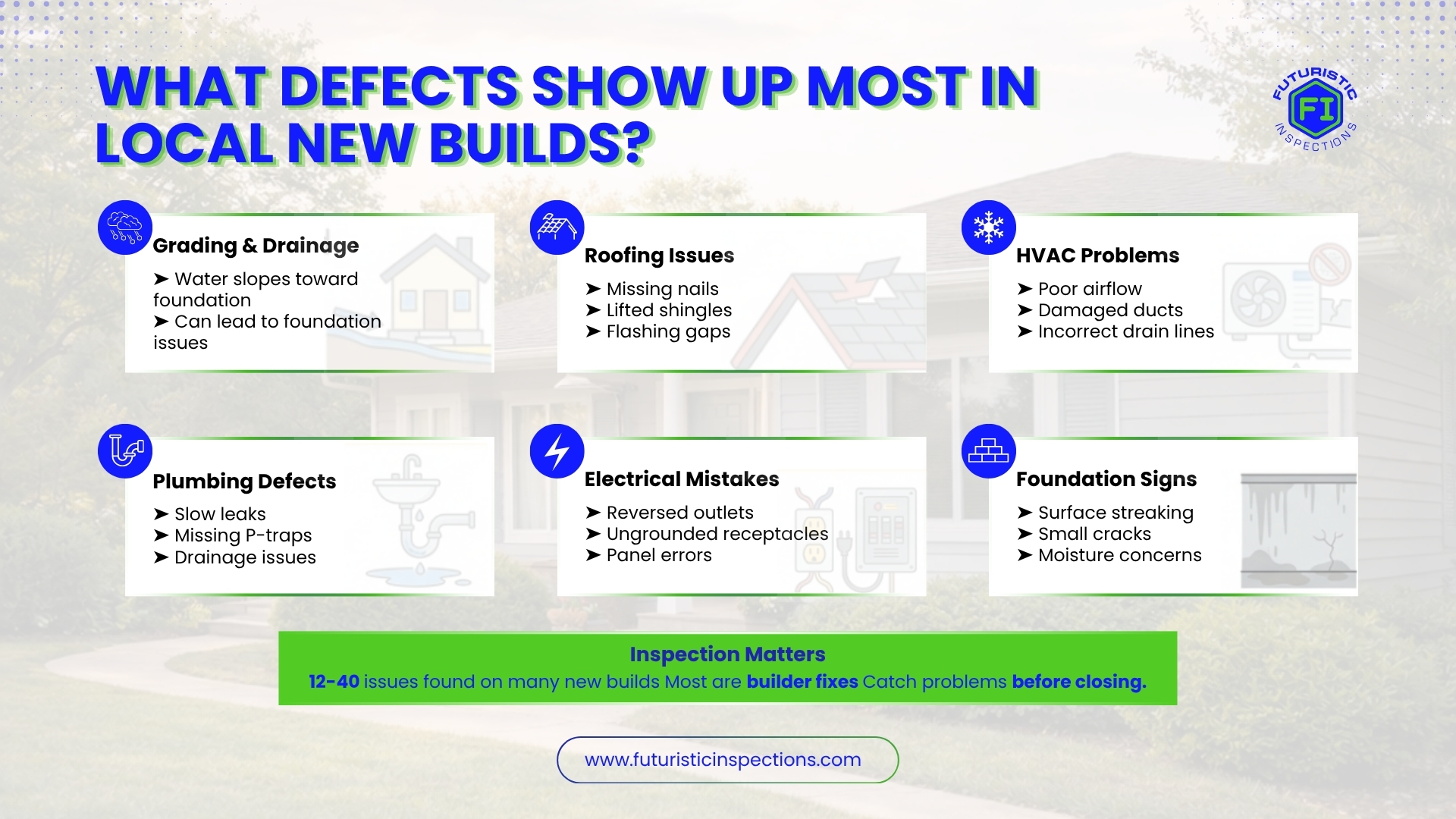
The most common defects in North Texas new builds cluster around drainage, framing shortcuts, HVAC, plumbing, and electrical work, and many trace back to the speed of construction. Here is what we find again and again on new homes in this market:
- Grading and drainage problems: Soil sloped toward the house instead of away from it, sending water to the foundation. On our clay soils, poor drainage is one of the surest paths to future foundation trouble.
- Roofing issues: Missing or improperly seated nails, lifted shingles, and flashing gaps around vents and valleys. These are easy to miss from the ground and easy for water to exploit.
- HVAC shortfalls: Disconnected or crushed ducts, rooms that get little airflow, and condensate lines routed poorly. In Texas heat, an undersized or leaky system costs you comfort and money every summer.
- Plumbing defects: Slow leaks at connections, missing P-traps, water heaters set up incorrectly, and fixtures that drain sluggishly.
- Electrical mistakes: Reversed polarity at outlets, ungrounded receptacles, open junction boxes, and panels with labeling or breaker errors. People ask which electrical safety check is right for them, and on a new build, the standard inspection covers these basics well.
- Foundation streaking and cracks: If you have ever wondered why a foundation looks streaky, it often points to moisture moving through the concrete or efflorescence, both worth a closer look on a new slab.
None of these means the builder did a bad job overall. They mean a house is built by many hands under a deadline, and a few things slip. Your inspector finds them, so the builder fixes them.
To put numbers on it, a typical new-build report from us lists somewhere between a dozen and forty items, with most falling in the cosmetic-to-moderate range. A handful are five-minute fixes the builder knocks out in a day. A few reports tend to be the kind that would cost you hundreds or thousands down the road if nobody flagged them, like a duct that came loose in the attic or a downspout dumping water against the slab. The point is not to scare you off a builder. It is to make sure the items that matter land on the builder’s punch list while there is still no charge to you.
The One-Year Warranty Inspection
The one-year warranty inspection is a full check of your home in the final weeks before your builder’s first-year coverage runs out, and it is one of the smartest moves a new homeowner can make. Most builders in Texas offer a warranty that covers workmanship and materials for the first year. As that deadline approaches, you get one last shot to have problems fixed on the builder’s dime.
The catch is that a year of living in the house, plus a full cycle of Texas weather, surfaces issues that were invisible at closing. The slab settles. Nail pops appear in the ceiling.
Caulk lines shrink. A door that closes fine in spring sticks by August. Grout cracks. A duct that was always a little loose finally announces itself with a warm bedroom.
A builder warranty inspection documents all of it in one report you submit before the clock runs out. Without that report, many of these repairs become your bills. We schedule these visits around the ten or eleven-month mark, so you have time to file the claim. A buyer who put off a new home inspection in McKinney at closing can still recover a lot of ground with this one well-timed visit.
It pays to read your warranty paperwork before the visit so you know what your builder actually covers. Most Texas builders follow a tiered structure: one year on workmanship and materials, two years on major systems like plumbing, electrical, and HVAC distribution, and up to ten years on the structure itself. Knowing those tiers helps you sort which items truly cannot wait. A sticking door belongs on the one-year list, while a slow drip behind a wall might still fall under the two-year systems window. Bring your purchase documents and any prior phase reports to the inspection so we can compare what was noted at closing against what the house is doing now.
How Does an Inspection Actually Protect My Purchase?
An inspection protects your purchase by turning unknown future repair bills into items the builder fixes for free, and by giving you written proof when you need it. The protection works on a few levels at once.
First, the timing works in your favor. While the warranty is active and the builder still has crews in your neighborhood, fixes are simple and free. After the warranty lapses, the same repair lands on you, and foundation or HVAC work runs into real money. An inspection puts problems on paper while the cost is still the builder’s to carry.
Second, a documented record. A written report with photos is hard for anyone to wave off. When you submit a clear list, you are not arguing about whether something is wrong; you are pointing at evidence. That changes the conversation with a builder’s warranty department. We have watched a one-line claim get brushed aside, then the same issue gets approved once it arrived with a dated photo and a plain description of what was wrong and where.
Third, peace of mind and resale value. Knowing the framing, roof, and systems were checked by someone working only for you lets you settle in without nagging doubt. And a home with a clean inspection history and addressed defects holds its value better when you sell, which matters in a market where buyers around McKinney and Frisco are paying attention to the local housing trends.
The math is plain. An inspection is a small one-time cost. A single missed foundation or drainage issue on North Texas clay can dwarf it many times over. That is the whole case for getting it done. Put another way, the inspection is one of the few line items in a home purchase that can pay for itself several times over on the very first repair the builder covers because you caught it in time.
Ready to Check your New Build the Right Way?
We have inspected new construction across Frisco, McKinney, Plano, and Prosper, and we know exactly where local builders tend to run short on time. If you are buying or about to hit your one-year mark, we will give you a written report you can hand straight to the builder. You can see how we work and book a visit at Futuristic Inspections, and we will walk through the findings with you in plain language.
Frequently Asked Questions
Do I really need an inspection if the city already inspected my new home?
Yes. The municipal inspector confirms the build meets minimum code on a fast schedule and works for the city, not for you. An independent inspector looks closely at quality and function on your behalf, which is a different job that regularly turns up issues the city sign-off missed.
What is the difference between a phase inspection and a final inspection?
A phase inspection happens during construction, at the foundation and pre-drywall stages, so the inspector can see framing, wiring, and plumbing before they get covered. A final inspection happens on the finished house before closing. Doing both gives the fullest picture, but the pre-drywall check tends to reveal the most.
When should I schedule the one-year warranty inspection?
Aim for around the ten or eleven-month mark, before your builder’s first-year warranty expires. That leaves time to get the report, file a claim, and have the builder make repairs for free while coverage is still active.
Which inspection covers a home’s major mechanical systems?
A standard home inspection covers the major mechanical systems, including HVAC, plumbing, and electrical, along with the roof, foundation, and structure. On a new build, that same scope applies, so you get all of those systems checked in one visit.
What are the most common problems found in North Texas new builds?
Drainage and grading issues, roofing and flashing gaps, HVAC duct problems, small plumbing leaks, and electrical wiring mistakes top the list. Many tie back to the fast pace of local construction, and almost all are easy fixes when caught while the builder is still responsible.